










A business can spend millions on cybersecurity, install surveillance cameras, require keycards at every entrance, and still leave one of the biggest vulnerabilities completely exposed: the hiring process.
Because fraud does not always arrive wearing a ski mask.
Sometimes it arrives with a polished résumé, a confident smile, glowing references, and a perfect interview.
And in many cases, employers unknowingly hand over access to customer data, financial systems, company vehicles, inventory, intellectual property, patient records, or vulnerable populations before discovering the truth.
That is why modern background screening is no longer just an HR task. It is a risk-management strategy.
Prime Screening helps employers uncover critical information before a bad hire becomes a costly mistake.
The Numbers Employers Cannot Ignore
The cost of hiring the wrong employee can be staggering.
The U.S. Department of Labor has long cited that a bad hire can cost at least 30% of the employee’s first-year earnings. For a $75,000 employee, that is approximately $22,500 — and that figure often does not include theft, fraud, legal exposure, lost customers, reputational damage, or operational disruption.
Now consider this:
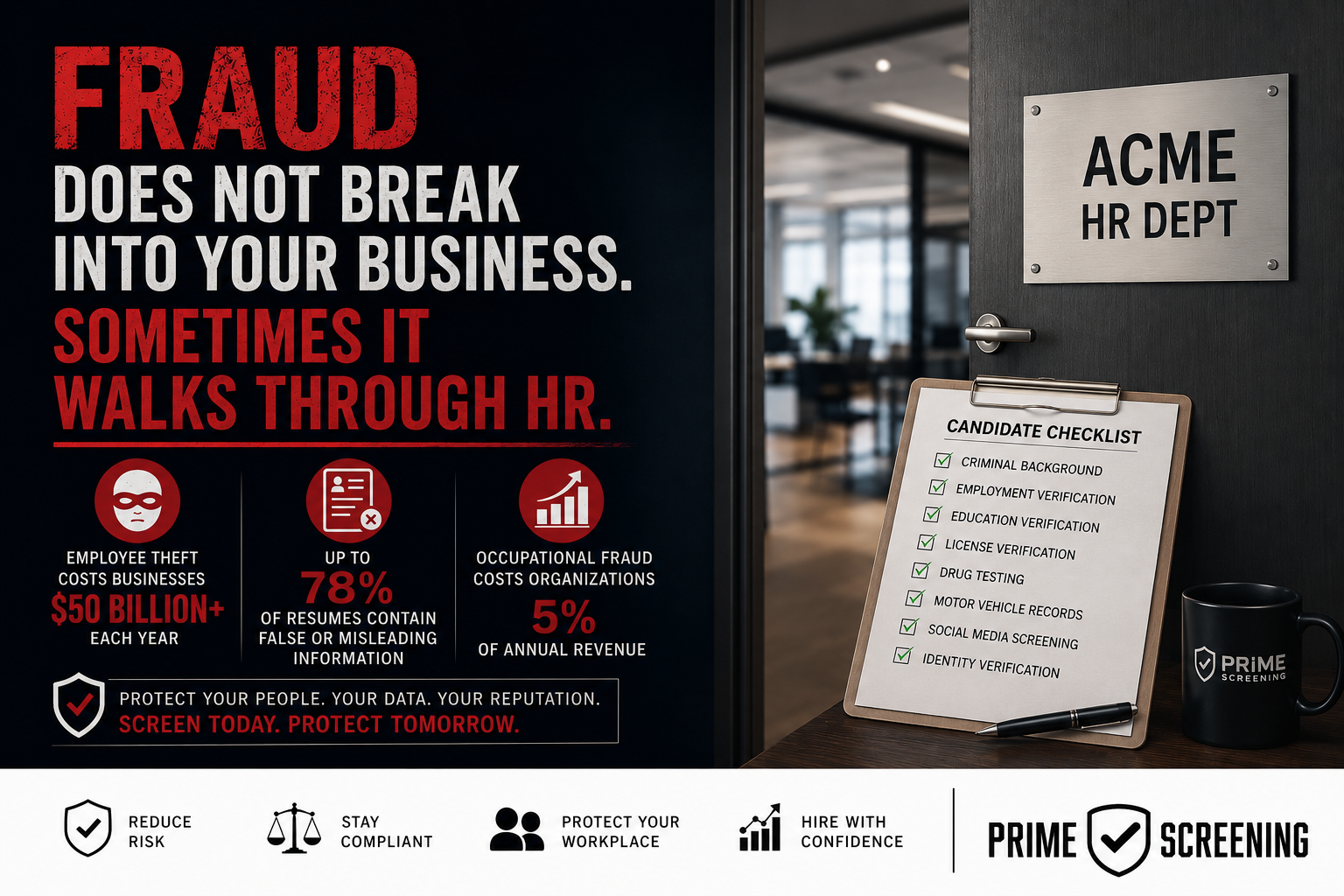
- Occupational fraud costs organizations an estimated 5% of annual revenue globally, according to fraud examiners and industry research.
- Employee theft in the United States is estimated to cost businesses tens of billions of dollars annually.
- Resume fraud remains widespread, with studies consistently showing many applicants exaggerate, alter, or completely fabricate portions of their work history, credentials, skills, or education.
- Insider threats continue to rise as employees gain access to increasingly sensitive digital systems, customer records, payment platforms, and proprietary information.
The frightening reality is that many businesses never see the warning signs until after the damage is done.
The Modern Workplace Has Increased the Risk
Today’s hiring environment moves fast.
Companies are under pressure to fill positions quickly. Remote hiring has become common. Applications arrive digitally. Interviews happen on Zoom. Employees may never even step foot into headquarters before receiving access credentials.
That speed creates opportunity — not just for businesses, but for bad actors.
Fraudsters today can use:
- Fake employment histories
- Synthetic identities
- Purchased references
- AI-generated resumes
- Fake certifications
- Stolen credentials
- Manipulated social media profiles
In some industries, one bad hire can create catastrophic consequences.
Healthcare
A fraudulent or dangerous employee can gain access to patients, medications, or sensitive medical records.
Financial Services
An employee may gain access to banking systems, financial data, or customer accounts.
Education
Schools and camps trust staff with children and vulnerable individuals.
Transportation & Logistics
Drivers and operators may be entrusted with expensive vehicles, cargo, and public safety.
Retail & Hospitality
Employees may handle cash, customer payment information, inventory, and customer-facing interactions.
Technology
A single insider can compromise proprietary systems, databases, or intellectual property.
The point is simple: hiring is no longer just about filling positions. It is about protecting the business.
Fraud Often Starts Small
Many employers imagine fraud as dramatic criminal behavior.
But in reality, it often begins with smaller warning signs:
- An undisclosed criminal history
- A suspended driver’s license
- A fake diploma
- A falsified employment gap
- Prior workplace violence
- Financial distress tied to fraud risk
- Social media activity involving threats, hate speech, or harassment
- Identity inconsistencies
These red flags may seem minor individually. Together, they can reveal patterns that employers cannot afford to ignore.
The Hidden Cost of “Trusting Your Gut”
Many hiring managers believe they can “read people.”
But experienced fraudsters know how to interview well.
Some of the most damaging employees:
- Are charismatic
- Interview confidently
- Build trust quickly
- Appear polished and professional
- Know exactly how to answer behavioral questions
Unfortunately, instincts are not a screening process.
Verification is.
That is why comprehensive screening solutions have become essential for organizations of all sizes — not just Fortune 500 companies.
Background Screening Is About More Than Criminal Checks
Many employers still think a background check simply means searching for criminal records.
Modern screening is far more comprehensive.
Depending on the position and industry, employers may need:
- Criminal background checks
- Employment verification
- Education verification
- Motor vehicle records
- Drug testing
- Identity verification
- Professional license verification
- Credit-related checks where legally permitted
- Social media background screening
- Ongoing monitoring solutions
Prime Screening’s services are designed to help employers build safer, smarter, and more compliant hiring processes across industries.
Prime Screening also offers compliant social media background checks that can help identify potential threats involving violence, harassment, hate speech, or other concerning behavior that traditional screenings may miss.
The Damage Is Not Always Financial
Some hiring mistakes cannot be measured in dollars.
One negligent hire can lead to:
- Workplace violence
- Public relations disasters
- Viral social media incidents
- Loss of customer trust
- Regulatory scrutiny
- Lawsuits
- Permanent reputational damage
And in today’s connected world, reputational damage spreads instantly.
A single employee incident can become tomorrow’s headline.
Smart Employers Are Becoming Proactive
The most successful organizations are no longer treating background screening as a checkbox.
They are integrating it directly into their hiring strategy, compliance process, onboarding workflow, and risk-management systems.
Modern screening platforms now integrate with ATS and HR systems to help organizations move faster while improving compliance and candidate experience.
That means employers no longer have to choose between speed and protection.
They can have both.
The Question Every Employer Should Ask
Before giving someone access to:
- Your customers
- Your employees
- Your systems
- Your finances
- Your vehicles
- Your facilities
- Your patients
- Your students
- Your reputation
…how much do you really know about them?
Because fraud rarely announces itself.
Sometimes it simply applies for the job.
Learn How Prime Screening Can Help Protect Your Organization
Prime Screening provides modern background screening and identity solutions designed to help employers hire with greater confidence, reduce risk, improve compliance, and protect what matters most.
Whether you are hiring one employee or scaling an entire workforce, the right screening strategy can make the difference between preventing a problem and reacting to one after the damage is already done.