











The next wave of entrepreneurship may not start with a pitch deck, a venture capitalist, or a newly registered startup name.
It may start with a domain name that already has power.
That is the idea behind The Beanstalk Challenge, a new skill-based entrepreneurial initiative built around premium domain names, AI-leveraged business creation, and a simple but provocative question:
What happens when talented builders get access to digital assets they likely could never afford to acquire on their own?
On its official website, the Beanstalk Challenge describes its mission as “turning domain names into real businesses” in public and in real time. The site currently lists 25+ builders, 50+ projects, and 20+ live builds, with examples including Unemployed.com, Cheapest.com, Violation.com, HelicopterCharters.com, TaxiDrivers.com, TradeShows.com, PoolRepair.com, ACrepair.com, BreakfastBars.com and others.
The challenge is led by Rick Schwartz, known throughout the domain industry as The Domain King®, whose portfolio has long included high-profile, memorable digital assets. DomainKing.com describes opportunities around domains through leases, joint ventures, advertising, angel financing, and other creative business structures.
For decades, the premium domain world was largely built around one question: How much is the name worth?
The Beanstalk Challenge reframes that question.
Now, the bigger question is: Who can build the business?

From “Landing Page Prison” to Real Businesses
The philosophy behind the Beanstalk Challenge is that too many powerful domain names have sat unused, underused, parked, or trapped on static landing pages while entrepreneurs, developers, marketers, operators and creators searched for their next opportunity.
The challenge is designed to connect those two worlds.
In simple terms, the domains provide the foundation. The builders provide the execution. The business becomes the multiplier.
Participants are selected based on their ideas, ability, creativity, strategy, execution potential and capacity to actually build something meaningful. This is not random participation. It is positioned as a skill-based entrepreneurial challenge where credentials, track record and vision matter.
Or, as the challenge’s philosophy puts it: your credentials are your passport.
The official site makes a similar point in blunt terms, describing the shift this way: for years domain names were “bought,” “sold,” and “parked,” but now they are being built into an ecosystem. It also states that the Beanstalk Challenge “isn’t a contest” but a live system where category-defining domain names are being built out by real builders.
How the Structure Works
The current structure is built around a partnership-style model.
Rick provides the domain, visibility, audience, platform, amplification and the opportunity itself.
The builder provides execution, development, creativity, strategy, marketing, operations and growth.
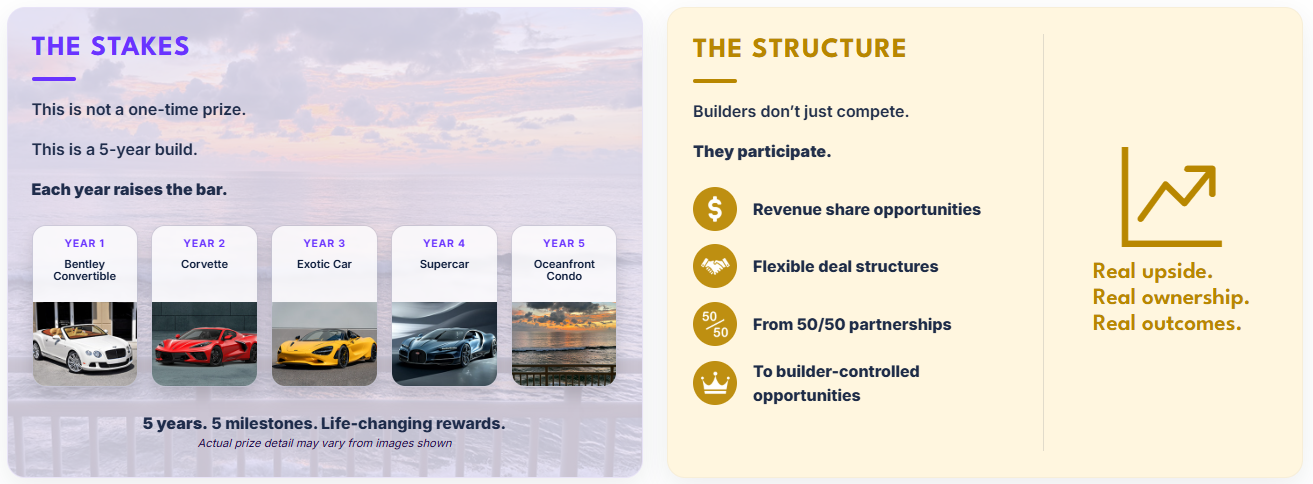
During operation of the business, the builder keeps 100% of net profits until agreed startup costs are recovered. After breakeven, the structure moves toward a 50/50 split between the builder and the domain owner.
There is also a potential longer-term path where a successful builder can earn majority operational ownership participation through execution, performance and growth. Under that kind of structure, the economics could evolve toward an 80% builder / 20% domain owner model.
The site also makes clear that submitting an idea is an inquiry only and does not automatically create a partnership, agreement or business arrangement.
That distinction matters.
The Beanstalk Challenge is not simply handing out domains. It is asking builders to prove they can turn a powerful asset into a real operating business.
Why AI Changes the Timing
The timing of the challenge is directly tied to the rise of AI tools.
A decade ago, building even a basic digital business often required larger teams, more capital, longer development cycles and deeper technical infrastructure. Today, AI-assisted coding, design, marketing, research, customer support, automation and content tools have dramatically lowered the barrier to launching and testing new business ideas.
That does not mean execution is easy.
It means the right builder can now move faster.
A developer can prototype quickly. A marketer can test demand. An operator can validate a business model. A strategist can use AI to compress research, design workflows and launch customer-facing products at a pace that previously may have required far more resources.
The Beanstalk Challenge is built around that new reality.
In the old model, the domain might have been the expensive prize at the end of the process.
In this model, the domain is the starting point.
The Public Incentives Are Big — But the Real Prize Is Ownership
The Beanstalk Challenge has also drawn attention for its public incentive ladder.
The official site describes the challenge as a five-year build, with each year raising the bar. The listed milestones include a Bentley Convertible in Year 1, a Corvette in Year 2, an exotic car in Year 3, a supercar in Year 4, and an oceanfront condo in Year 5, while noting that actual prize details may vary from images shown.
Those headline incentives are designed to get attention.
But the deeper value may be in something more meaningful: the opportunity for builders to participate in upside from real businesses built on powerful domain names.
Instead of taking a short-term gig, a consulting project, or a temporary assignment for $25,000, $50,000 or even $100,000, the challenge encourages builders to invest their talent into something with a future.
For the right person, the opportunity is not just to work on a domain.
It is to help create the business that domain was always capable of becoming.
A Long Island Connection
There is also a notable Long Island business angle.
The Beanstalk Challenge site lists Team Hazen on several current and in-build projects, including HelicopterCharter.com, TaxiDrivers.com, PoolRepair.com, ACrepair.com, BreakfastBars.com, AiDesigns.com, eDivorce.com, Solicit.com, Homemade.com, FaceFind.com, CarLocators.com and BirthdayParty.com. This reference is to father and son team Andrew & Oliver Hazen.
For Long Island entrepreneurs, marketers, developers, students and operators, the challenge represents a larger shift happening in real time: business creation is becoming faster, more digital, more AI-assisted and more dependent on the ability to execute.
Premium domains still matter. But now, they are being paired with builders who can move.
That combination could be especially relevant for Long Island’s growing base of entrepreneurs, media operators, digital marketers, e-commerce builders, creators and tech-enabled service businesses.
Who the Challenge Is Looking For
The Beanstalk Challenge is intentionally designed to attract increasingly sophisticated builders over time.
That includes entrepreneurs, developers, marketers, operators, product builders, content creators, AI power users, sales strategists and business creators who can look at a category-defining domain and see more than a name.
They must see a market.
They must see a customer.
They must see a business model.
Most importantly, they must be able to execute.
The challenge is not built for spectators. It is built for people who can take an asset, build quickly, test intelligently, and create something that has a chance to grow.
The Bigger Idea
At its core, the Beanstalk Challenge is about unlocking dormant value.
A premium domain can provide instant credibility, memorability, category relevance and brand authority. But without execution, even the best domain remains only potential.
The challenge is attempting to solve that problem by pairing digital real estate with entrepreneurial labor, creativity and AI-powered leverage.
That is what makes the model interesting.
It is part startup incubator, part domain partnership, part business-building challenge and part public experiment in how AI may reshape entrepreneurship.
The internet changed everything once before.
AI is changing it again.
And with the Beanstalk Challenge, Rick Schwartz is betting that the next generation of category-defining businesses may already have their names.
They just need the right builders to climb.