











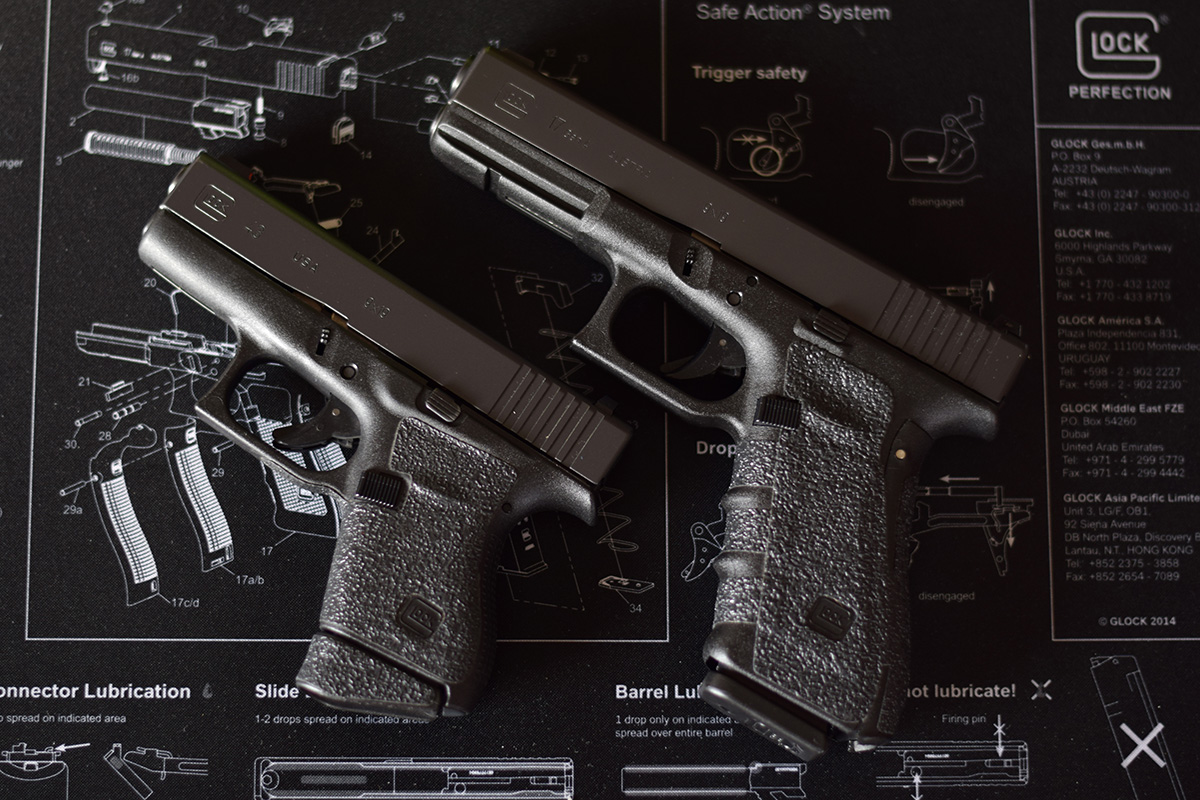
In May 2026, Governor Kathy Hochul signed New York’s Fiscal Year 2027 budget into law, embedding within it a firearms provision that has quickly become one of the most controversial developments in recent Second Amendment jurisprudence. Although widely characterized in public discourse as a “Glock ban,” the statute does not expressly outlaw a specific brand by name. Instead, it adopts a more novel and potentially far-reaching approach regulating firearms based on design characteristics that are common to a broad class of widely owned handguns.
At the center of the legislation is the creation of a new category of prohibited firearm described as a “convertible pistol.” The term, as developed through legislative proposals and incorporated into the budget framework, refers to semi-automatic handguns capable of being converted into fully automatic weapons through the addition of a conversion device. The crucial and legally significant aspect of the statute is how that potential for conversion is identified. Rather than focusing on actual illegal modifications or possession of banned devices, the law draws its scope from physical design attributes, particularly the presence of a so-called “cruciform trigger bar,” which is contained in arguably one of the most popular and widely owned classes of semi‑automatic pistols. Indeed, it is a standard component of Glock pistols and a wide range of Glock-pattern, striker-fired handguns that dominate both civilian and law enforcement markets. As a result, although the statute is framed in neutral, technical terms, its practical reach extends to a substantial segment of the handgun market. The effect is that a firearm may fall within the statutory prohibition based solely on its internal geometry, irrespective of whether it has ever been modified or even can realistically be modified by the particular owner.
Statutory Framework: The “Convertible Pistol” Classification
The budget bill introduces a new regulatory category – “convertible pistols” – defined as semi‑automatic handguns that can be transformed into machine guns through the installation of a conversion device.
In practice, the law’s scope expands significantly by targeting design features rather than conversion conduct:
The legislation has been described as covering any handgun with a “cruciform trigger bar.” A cruciform trigger bar is a key internal component of Glock-style, striker-fired handguns. Named for its cross shape (“cruciform”), it acts as a metal linkage that connects the trigger to the firing mechanism, allowing the gun to tension, hold, and release the firing pin.
This design attribute is common to Glock and Glock‑pattern striker‑fired pistols [1], making the law functionally applicable to a substantial segment of the handgun market. In practice, the scope of the law is a drastic expansion since it targets a design feature rather than conversion conduct or a device.
The legislative impetus for this approach lies in growing concerns over illegal conversion devices, commonly referred to as “Glock switches,” which can transform semi-automatic pistols into machine guns. These devices have long been prohibited under federal law, yet lawmakers have increasingly focused on the host firearm itself, arguing that certain designs make unlawful conversion too easy. The 2026 budget legislation reflects that shift in regulatory philosophy: rather than targeting only the illicit accessory, the statute extends liability upstream to the design of the firearm platform itself.
Legal and Practical Implications
From a practical standpoint, the law operates most clearly in the context of commercial activity. Reporting indicates that New York will prohibit the sale of pistols deemed “convertible” under the statute, effectively barring dealers from introducing new inventory that meets the defined criteria. In ordinary terms, this means that commonly sold Glock-style handguns may no longer be available for purchase in the state unless manufacturers alter their designs to eliminate the perceived susceptibility to modification. Legislators have been explicit on this point, indicating that manufacturers would regain access to the New York market if they redesign their products to prevent such conversions.
At the same time, there are indications that the law is primarily prospective in its application. Existing owners do not appear to be the primary target of the legislation and available reporting suggests that currently lawfully possessed firearms may not be newly criminalized, though implementation details remain subject to clarification and, almost certainly, litigation. That distinction between restricting future commerce and penalizing present possession will likely prove pivotal in both enforcement and judicial review.
If the statute’s practical implications are significant, its constitutional implications may be even more so. The modern Second Amendment framework, as articulated in District of Columbia v. Heller and New York State Rifle & Pistol Assn., Inc. v. Bruen, focuses heavily on whether a regulated firearm is “in common use” for lawful purposes. Glock-style handguns plainly meet that description; they are among the most widely owned firearms in the United States and are routinely used for lawful self-defense.
Against that backdrop, the central constitutional question becomes whether a state may restrict a commonly used firearm not because of its inherent function, but because of its theoretical susceptibility to unlawful modification. The Hochul administration and legislative sponsors appear to answer that question in the affirmative, framing the statute as a public safety measure addressing evolving threats in firearm technology. Critics, however, argue that the law impermissibly shifts the burden of criminal misuse onto law-abiding owners, effectively banning an entire class of firearms based on hypothetical misconduct that is already illegal under existing law.
Compounding these substantive issues is the procedural context in which the law was enacted. The firearm provisions were embedded within a multi-hundred-page budget bill, rather than advanced as stand-alone legislation. While this practice is not unusual in Albany, it has drawn criticism in this instance due to the magnitude of the policy change and its constitutional implications. For opponents, the use of the budget process reinforces the perception that the law represents not merely a regulatory refinement, but a significant, and potentially vulnerable expansion of firearm restrictions.
Unsurprisingly, litigation appears imminent. Industry groups and Second Amendment advocates have already signaled their intent to challenge the law, and given New York’s recent history following Bruen, any such challenge is likely to move quickly through the federal courts. The outcome will turn on how courts apply the historical-tradition test to a statute that regulates firearm design at this level of abstraction – a question that remains largely unsettled.
Ultimately, New York’s “convertible pistol” law represents a marked shift in regulatory strategy. It does not simply criminalize conduct or prohibit accessories; it conditions the legality of a firearm on how it is engineered. Whether that approach can withstand constitutional scrutiny and whether it becomes a model for other jurisdictions, will largely be determined in the litigation now sure to be on the horizon.
[1] A striker-fired pistol is a handgun that uses a spring-loaded firing pin (the striker) to strike the cartridge primer, rather than a traditional hammer.
For more information, please contact:
Craig H. Handler, Esq.
(516) 663-6506