










The auditorium at the Suffolk Y Jewish Community Center in Commack was nearly filled to capacity as more than 300 educators, guidance counselors, administrators, and business leaders gathered on November 4 for HIA-LI’s first-ever Long Island Workforce Summit. The buzz began early in the morning as the check-in area filled with educators networking alongside construction executives, engineers, and healthcare leaders—an uncommon sight that symbolized exactly what the summit aimed to achieve: stronger communication between education and industry.
Hosted in partnership with the Smithtown Central School District, the event carried the theme “Pipeline: Education-to-Industry,” a concept inspired by the Workforce Development Study conducted by the Workforce Development Institute in collaboration with HIA-LI and the Suffolk County Industrial Development Agency. That report called for greater alignment between Long Island’s classrooms and its employers, identifying the need to better prepare students for the evolving world of work.
“This event was an unprecedented dialogue between business and education,” said Terri Alessi-Miceli, President and CEO of HIA-LI. “The energy in the room showed how much people want to work together. Educators and business leaders alike told us they left with new ideas and a renewed sense of possibility.”
State Senator Mario Mattera, who opened the program, praised the collaboration taking shape. “When we work together like this—business, labor, and education—we give our young people real opportunities and strengthen Long Island’s future,” he said.
A Shared Call for Collaboration
Throughout the plenary session, a central message emerged: schools and employers must communicate more closely to bridge the gap between classroom learning and workforce readiness. Many speakers emphasized that a four-year degree, while valuable, is no longer the only route to a stable, rewarding career.
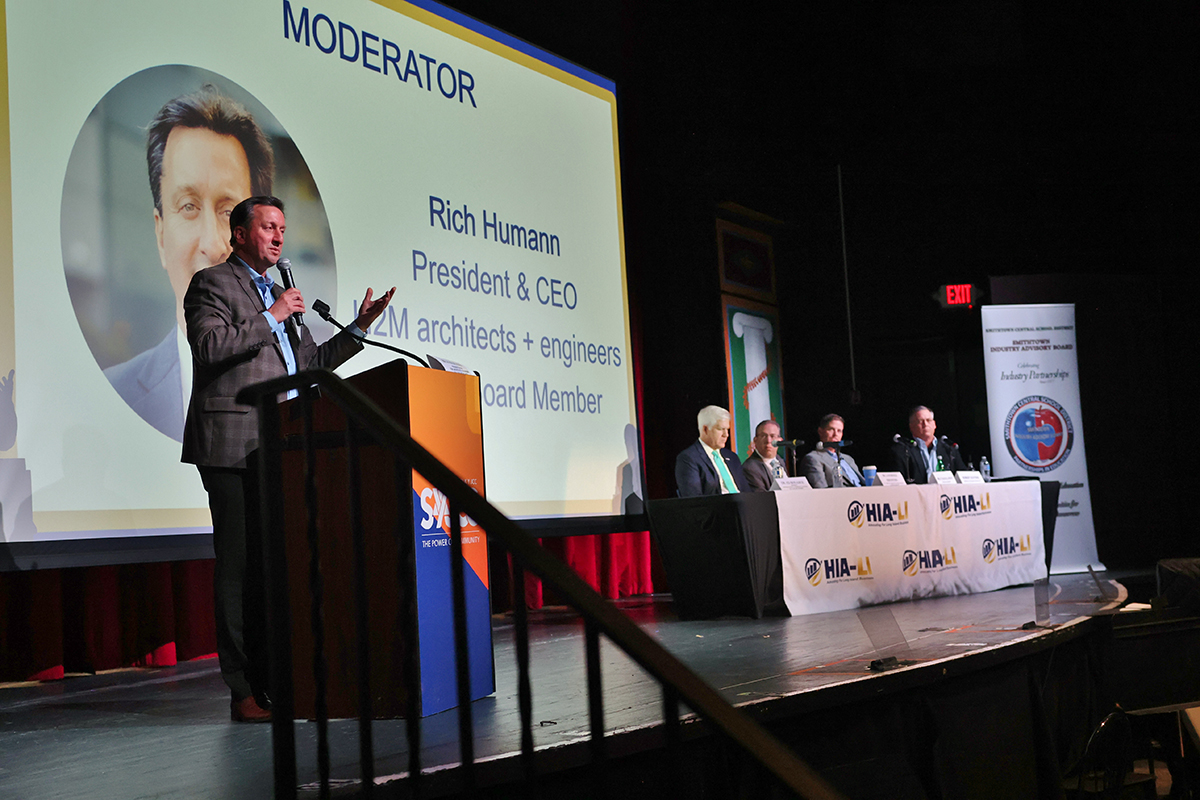
Rich Humann, President and CEO of H2M architects + engineers; HIA-LI Board Member; and Co-Chair of HIA-LI’s Workforce Development Task Force, said the summit turned research into real-world connection. Employers today, he explained, are looking for graduates who can think critically and collaborate effectively. “Our challenge—and opportunity—is to help schools translate those expectations into classroom experiences that prepare students for success,” he said.
That same theme was echoed by Dr. Ed Bonahue, President of Suffolk County Community College; HIA-LI Board Member; and Co-Chair with Humann on HIA-LI’s Workforce Development Task Force. He noted that higher education must become more flexible and responsive. “We’re expanding micro-credentials and certificate programs so students can enter the workforce faster, equipped with the precise skills that employers need,” he said.
Keynotes: Redefining the Pathways to Success
The summit’s dual keynote speakers, Michael Woods, Director of the CTE Technical Assistance Center (CTE TAC) of New York, and Janine Lalia, Long Island/New York City Regional Field Associate for CTE TAC, set a forward-looking tone. Woods urged both educators and employers to move beyond occasional collaboration toward sustained partnership. “Education can’t exist in a silo,” he said. “We need to co-design learning experiences with business so students graduate ready to contribute from day one.”
Lalia reminded the audience that teachers and guidance counselors are often the first to shape students’ perceptions of success. “When we celebrate all career pathways equally— college, technical training, and the trades—we create stronger students and a stronger economy,” she said.
Multiple Pathways, One Goal
The morning’s industry panel brought together voices from across Long Island’s business landscape. Construction, manufacturing, healthcare, and higher education leaders all agreed that students need exposure to diverse career opportunities early—and that removing the stigma around vocational and technical paths is critical to keeping talent on Long Island.
Apprenticeships, several panelists observed, offer a powerful alternative to the rising costs of traditional education. “You can earn while you learn and build a career that offers both security and pride,” said Billy Haugland II, CEO of Haugland Group.
Manufacturing, too, has evolved into an industry defined by technology and precision rather than manual labor. “Modern manufacturing is high-tech, clean, and creative,” said Robert Kufner, President and CEO of Designatronics Inc. “We need to show young people that it’s
an exciting, well-paying field—and it’s right here on Long Island.”
Healthcare leaders expanded the conversation beyond the trades and technology sectors. Dr. Lawrence Eisenstein, Vice President and Chief Public and Community Health Officer at Catholic Health, pointed out that the medical field offers a wide spectrum of fulfilling, well- paid careers. “Young people often think healthcare means becoming a doctor, but doctors are just one part of the care team,” he said. “There are incredible opportunities as nurses, technologists, EMTs, and administrators. We need to make sure students understand that the healthcare industry welcomes a wide variety of skills and aspirations.”
From Dialogue to Action
After the plenary, attendees divided into breakout sessions that explored practical next steps: expanding school-industry advisory boards, strengthening apprenticeship programs, and developing new models for technical training. Many participants said these smaller sessions were among the most valuable parts of the day.
“When educators and employers sit together, students gain greater options and better access to internships and training,” said Phil Como, Executive Director of the Smithtown Industry Advisory Board. “That’s how we connect education to opportunity.”
As attendees left the auditorium, the energy from the day’s discussions lingered. New partnerships had been sparked, and many agreed the summit represented a genuine shift in how Long Island’s educational and business communities see one another.
For Alessi-Miceli, that was exactly the goal. “This summit was not an end but a beginning,” she said. “HIA-LI’s Workforce Development Task Force will continue to advance these partnerships, ensuring that Long Island students can learn, work, and build their futures right here at home.”
For more information about HIA-LI’s Workforce Development Task Force or the 2023 Workforce Development Study, visit www.HIA-LI.org.